Don Bosco Artisans
Artesanos Don Bosco is an association founded in 1985 by Father Ugo de Censi with the goal of providing training and employment to young people in the Peruvian Andes, allowing them to thrive without leaving their communities. It was born from Father Ugo’s dream of offering work to the poorest young people while restoring the old altarpiece of the church in Chacas, which had been severely damaged by fires and earthquakes.
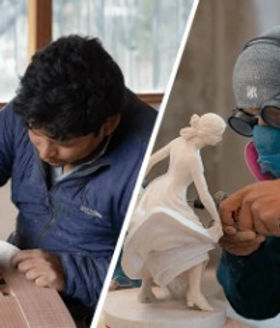
Father Ugo, a Salesian priest deeply rooted in Don Bosco’s educational method, was convinced that artistic work could help prepare young people for a better future. Through its workshops, more than 400 artisans specialize in carpentry, sculpture, weaving, and other crafts, combining tradition with excellence.
Each piece reflects the association’s commitment to local development, education, and the values of Operazione Mato Grosso. Many volunteers and teachers from diverse disciplines have made this dream possible and continue to support and enrich the workshops with their expertise. (Don Bosco Artisans Family and Mama Ashu Association)
Each design carries a story,
each piece is a legacy that transforms your space.
https://artesanosdonbosco.org/

One of the first designs by the artisans of Chacas for the international market, this robust armchair—first carved more than 30 years ago—continues to be produced today and retains its success intact, becoming a true symbol of the artisans of Chacas.


From the Andes to the heart of the Vatican
It was a deeply moving experience to meet Pope Leo XIV on Saturday, January 31, for all of us who belong, in different ways, to the “Don Bosco Artisans Family” of Peru. On that occasion, the Peruvian Episcopal Conference presented the Pope with two works that are now permanently displayed in the Vatican Gardens. They were created by the “Don Bosco artisans,” a reality involving around 400 young people, inspired by the charism of Father Ugo de Censi, founder of Operation Mato Grosso. These artisans were trained in workshop schools in various parishes in the Andes of Peru and, on the very day of the feast of Saint John Bosco, were able to see just how far their art, dedication, and passion for work could reach. The two works were commissioned by the bishops of the Peruvian Episcopal Conference on the occasion of the ad limina visit, as a gift to the Pontiff. The first work is a mosaic intended to represent a Virgin of Peru. Following the bishops’ guidance, several of the most widespread devotions from the coast, the highlands, and the jungle were chosen, also seeking historical connections among them. At the center is the image of the Immaculate Conception, probably the first major devotion to arrive in the Americas and the only dogma represented in a figurative-symbolic form. Around it, like a flower made up of oval medallions in the style of large colonial canvases of Cusco art, are other Marian representations united by a two-colored ribbon, like the national flag, which brings all Marian invocations together into a single prayer. At the top appears the Virgin of the Gate, placed by the first missionaries to protect the northern coasts; on the left are several Virgins of Candelaria, especially dear to the southern populations and likely originating historically from neighboring Bolivia. On the right are the two great national devotions: the Virgin of Carmen and the Virgin of Mercy. At the bottom, completing the flower, is the Virgin of Evangelization, a Rosary Madonna whose beautiful image—perhaps the oldest—can still be seen in the Cathedral of Lima. As a background to this geographical and historical panorama of Marian devotions in Peru, various decorations inspired by the main pre-Incan cultures appear, like a tapestry prepared over the centuries to welcome the message of Salvation. The mosaic was created by eight young people from the Don Bosco workshop in Chacas, together with master Lenin Álvarez (an artist from Cajamarca), who was present at the inauguration and presented the works and their meaning to the Holy Father. Its execution required more than six months, and for some details of the medallions with the Virgins, the micromosaic technique was used. In this regard, special thanks are due to Gabriele Mattiacci and Emanuela Rocchi from the Fabric of Saint Peter, who have shared their expertise with our schools for several years. Indeed, thanks to one of their visits to Chacas and other missions some years ago, Father Ugo had the idea of starting a mosaic workshop—an initiative that made it possible for us to stand before the Pope today with our works. The second work donated to the Vatican Gardens is a statue of Saint Rose of Lima (1586–1617), the first canonized person born in the Americas. Known for her profound mystical life and service to the poor, Isabel Flores, Saint Rose, is the patron saint of the Americas and the Philippines. The work is signed by Edwin Morales, sculptor and master of the workshop in Jangas (Huaraz). The marble used also comes from Peru: it is travertine from Huancayo. To decide the iconography of the saint, a drawing contest was organized among the young people in the workshops. It was an opportunity to listen to the bishops’ vision of Saint Rose and to discover together the meaning of certain symbols and her impressive story of faith and service. Because of her great devotion to the Child Jesus, she was depicted embracing Him, as He appeared to her mystically on various occasions and symbolically offered her a nuptial ring and a bouquet with three roses: “Will you be my bride?” It is said that from a young age she consecrated her life to Jesus and, for His sake, endured suffering, humiliation, and sacrifice. Her life of prayer is represented by the large rosary at her side and by the habit of a Franciscan and later Dominican tertiary that she wears. At her feet, besides the roses, a large anchor recalls the miracle by which she protected the city of Lima from a pirate attack; at the same time, it symbolizes her great faith and sums up a life anchored in God. In the convent in Lima where Saint Rose lived, there is a well where devotees leave their prayers and entrust their concerns and dreams. This gesture of devotion—so widespread and significant throughout Peru—was also reproduced in the Vatican Gardens statue: leaving our unresolved problems to the Lord, asking for help, and entrusting ourselves to the saints, the Virgin Mary, and Christ, with the certainty that only the Lord can change things and that hope must be placed in Him alone. At the base of the statue, also in travertine from Huancayo, a wooden chest carved with roses and a large golden cross was placed. Inside, the bishops deposited scrolls with prayers for their communities and dioceses. There are the names of all the prelatures, vicariates, and dioceses of Peru, as well as their shepherds, along with their prayers and concerns: everything is entrusted to the Lord through a statue that symbolizes an entire praying community reaching the Holy Father with immense gratitude and, together with him, looking to the future with hope.


Masters, artisans of noble wood and the hardest stone, shaped with the precision of sacred art and the most intricate carving. Creators of the most detailed mosaics and multicolored tempered glass, of unique murals, delicate cast pieces, and every handcrafted detail. Masters of natural weaving, marquetry, and decorative accessories. Artisans, through and through.